Showing posts with label linus pauling. Show all posts

Saturday, April 5, 2014

High-Dose Vitamin C for Cancer

 High-Dose Vitamin C Injections Shown To Annihilate Cancer Cells

High dose vitamin C injections have shown positive results in fighting cancer cells in studies done in vitro, on mice and on humans. Peer-reviewed medical research has been recently published in the journal Science Translational Medicine that reports the findings of a team of researchers from the University of Kansas who tested the effects of vitamin C given in high doses intravenously on a group of human subjects with cancer. They found that the injections fought cancer cells yet left healthy cells well intact unlike chemotherapy.

The BBC reports that vitamin C effectively targeted ovarian cancer cells while completely avoiding healthy cells. The benefits of high-dose vitamin C injections were also observed in conjunction with chemotherapy. Some are suggesting that the injections provide a great boost alongside chemo treatment. However chemo does destroy all cells, both healthy and not and is often the cause of death for cancer patients.

Research on high dose vitamin C injections began in the 1970s when Linus Pauling, a chemist from Oregon State University began his research. New research involved injecting high doses of vitamin C intravenously into human ovarian cells. The tests were conducted in vitro, on mice and in 22 humans subjects.
“Patients are looking for safe and low-cost choices in their management of cancer… Intravenous vitamin C has that potential based on our basic science research and early clinical data.” Dr. Jeanne Drisko, a co-author of the study.

Researchers admit more research is unlikely because drug companies cannot patent vitamins.

Generally the next step in this type of research would be creating human clinical trials that are much larger. Regardless of the fact this study is quite convincing, larger and more widespread testing would need to be done. But these types of trials cost a great deal of money. While clinical trials are often funded by large drug companies when testing out new medications, the researchers involved in this study feel drug companies won’t fund such research because they can’t patent the natural substance that is vitamin C. Allowing research like this could potentially destroy the multi-billion dollar cancer industry.
“Because vitamin C has no patent potential, its development will not be supported by pharmaceutical companies… We believe that the time has arrived for research agencies to vigorously support thoughtful and meticulous clinical trials with intravenous vitamin C.” Qi Chen, lead author of the new study.
Conventional medicine has a hard time accepting studies like this as they would have a lot of questions to answer should they admit the validity of this research. They would have to explain why this type of knowledge has been known for decades and yet low percentage, barbaric and expensive methods like radiation and chemotherapy remain the number one method in treating cancer. This would also come with a huge loss in profit due to the fact that most proven and effective cancer treatments like this and cannabis oil are very cheap to produce.
“[A]scorbate is processed by the body in different ways when administered orally versus intravenously… Oral doses [of vitamin C] act as antioxidants, protecting cells from damage caused by reactive compounds that contain oxygen. But vitamin C given intravenously can have the opposite effect by promoting the formation of one of those compounds: hydrogen peroxide. Cancer cells are particularly susceptible to damage by such reactive oxygen-containing compounds.” Heidi Ledford for Nature
by Joe Martino - 

Sources:
http://www.nature.com/news/vitamin-c-injections-ease-ovarian-cancer-treatments-1.14673
http://www.bbc.com/news/health-26038460
http://science.naturalnews.com/vitamin_c.html
http://lpi.oregonstate.edu/infocenter/vitamins/vitaminC/


Saturday, July 27, 2013

RATH/PAULING U.S. PATENT # 5278189

Scientific Health Journal: RATH/PAULING U.S. PATENT # 5278189

Scientific Health Journal: RATH/PAULING U.S. PATENT # 5278189#links

SUMMARY OF THE INVENTION

The foregoing needs in the treatment and prevention of cardiovascular disease are met by the methods and compositions of the present invention.

A method is provided for the treatment of occlusive cardiovascular disease , comprising the step of administering to a subject an effective amount of ascorbate and one or more binding inhibitors, as a mixture or as a compound comprising ascorbate covalently linked with binding inhibitors, which inhibit the binding of Lp(a) to blood vessel walls, such as arterial walls. This effect may also be obtained by administering an effective amount of one or more inhibitors, without ascorbate. The term binding inhibitor throughout the specification and claims is intended to include all substances that have an affinity for the lysine binding site present on the interior walls of blood vessels, particularly arteries, the site of Lp(a) binding. Most of these substances compete with plasmin for the lysine binding site and some of these compounds, in high doses, are in clinical use for the treatment of hyperfibrinolytic states.

A method is further provided for the prevention of atherosclerosis comprising the step of administering to a subject an effective amount of ascorbate and one or more binding inhibitors as previously discussed but further comprising one or more antioxidants. The term antioxidant throughout the specification and the claims is intended to exclude ascorbate which has as one of its chemical properties a potent antioxidant effect.

It is thus an object of the invention to provide a method for treatment of occlusive cardiovascular disease by administering to a subject an effective amount of ascorbate and one or more binding inhibitors, or an effective amount of one or a mixture of binding inhibitors.
It is another object of the invention to provide a method for preventing o f occlusive cardiovascular disease, by administering to a subject an amount of ascorbate effective to lower the amount of Lp(a) in the plasma of the subject.

Yet another object of the present invention is to provide a method for prevention of cardiovascular disease by administering to a subject an effective amount of ascorbate and one or more binding inhibitors, or an effective amount of one or more binding inhibitors.
A further object of the present invention is to provide a pharmaceutically acceptable agent for the treatment of occlusive cardiovascular disease.

Still another object of the present invention is to provide a pharmaceutically acceptable agent for the prevention of cardiovascular disease.

These and other objects will be more readily understood upon consideration of the following detailed descriptions of embodiments of the invention and the drawings.


DETAILED DESCRIPTION OF THE INVENTION

Our invention is based in part on our discovery that animals which have lost the ability to produce ascorbate, such as higher primates and guinea pigs, uniformly produce Lp(a). Most animals which possess the ability to synthesize ascorbate generally do not produce Lp(a).

Further, we have found that ascorbate deficiency in humans and guinea pigs tends to raise Lp(a) levels and causes atherosclerosis by the deposition of Lp(a) in the arterial wall, from which we conclude that ascorbate administration lowers plasma Lp(a) levels.

We have also discovered that substances that inhibit the binding of Lp(a) to components of the arterial wall, particularly to fibrinogen, fibrin and fibrin degradation products herein identified as binding inhibitors, such as lysine or .epsilon.-aminocaproic acid used alone or in combination with ascorbate, cause release of Lp(a) from the arterial wall. Thus, ascorbate and such binding inhibitors are not only useful for the prevention of occlusive cardiovascular disease, but also for the treatment of such disease. The present invention, then, provides methods and pharmaceutical agents for the both the treatment and prevention of occlusive cardiovascular disease in vivo. 

 
For GENERAL APPLICATIONS Click Here.


 SOURCE: http://armyoflifesavers.blogspot.com/2012/10/scientific-health-journal-rathpauling.html

Tuesday, June 11, 2013

VIT C RDA ERROR

Interesting critter category:
Guinea pigs, apes, fruit bats and humans

What do guinea pigs, apes, some fruit bats and humans have in common? They all share the inability to produce their own ascorbic acid (vitamin C). All other animals produce vitamin C endogenously, or inside their own bodies.

Scientists believe they have evidence suggesting that humans used to produce their own ascorbic acid from an enzyme produced in the liver. But something happened and humans now depend on dietary sources of vitamin C.

Guinea pigs, apes, some fruit bats and humans share another trait: The tendency to develop coronary heart disease. The development of heart disease only occurs in animals and humans that lack adequate intake of ascorbates through dietary sources.

It has also been observed that zoo animals, such as gorillas fed processed "gorilla chow" readily develop heart disease unless they are supplied with adequate amounts of ascorbates.

By comparing the amount of vitamin C produced endogenously in animals that do not develop heart disease, we can get a good idea of how much vitamin C is essential to maintain cardiovascular health in humans.

Goats, cows, dogs, cats, squirrels and rabbits manufacture ascorbic acid at a rate of about 10 g per 70 kg (154 pounds) of body weight. In other words, to achieve the levels of ascorbic acid produced by animals that do not develop coronary heart disease, a 154-pound human would need to ingest 10 g of dietary or supplemental vitamin C daily.

Noting that 1,000 mg = 1 g, the U.S. Food and Drug Administration has established the U.S. Recommended Daily Allowance (RDA) for vitamin C at 35 mg for infants; 45-50 mg for children and 60 mg for adults.

According to the FDA, humans require about 200 times less vitamin C than animals to maintain optimal health.

The late Dr. Fred Klenner was one of the world's foremost authorities on vitamin C. He believed that the government's concept of daily minimal intakes should be abolished because, "The physiological requirements [for ascorbic acid] in man are no different than other mammals capable of carrying out this synthesis."

Judging from the numbers of people being stricken by and succumbing to heart disease in the U.S., it would appear that Dr. Klenner (and doctors Pauling, Irwin Stone, Glenn Dettman and Archie Kalokerinos) are correct about the levels of ascorbic acid necessary to maintain optimal cardiovascular health.

Source: http://advancedscientifichealth.blogspot.com/2011/03/interesting-critter-category.html

Saturday, June 16, 2012

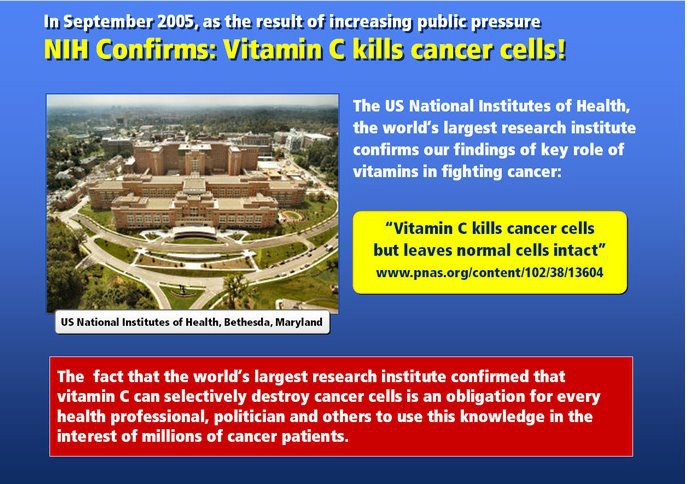
Vitamin C Kills Cancer Cells

CONFIRMED
Vitamin C KILLS Cancer Cells


The National Institute of Health (NIH), the National Cancer Institute (NCI) and the Food and Drug Administration (FDA)  have finally confirmed the research findings that Linus Pauling, PhD, Hugh Riordan, MD and many other scientists and physicians over the past few decades have conducted regarding the therapeutic utility of treating cancer with vitamin C.
The NIH study confirms in vitro, the hypotheses described by Riordan et al in “Intravenous Ascorbate as a Chemotherapeutic and Biologic Response Modifying Agent”:
  1. Tumor cells are more susceptible to the effects of high-dose, ascorbate-induced peroxidation products because of a relative catalase deficiency.
  2. Concentrations of ascorbate high enough to kill tumor cells can be achieved in humans.
Neil H. Riordan PhD. commented on the study, “It is gratifying to have our research on vitamin C and cancer confirmed by scientists at the prestigious National Institutes of Health.”

Listed below are several, peer reviewed references regarding vitamin C as it pertains to the treatment of cancer.
Pharmacologic ascorbic acid concentrations selectively kill cancer cells: Action as a pro-drug to deliver hydrogen peroxide to tissues
Qi Chen *, Michael Graham Espey, Murali C. Krishna, James B. Mitchell, Christopher P. Corpe *, Garry R. Buettner, Emily Shacter, and Mark Levine * Reference Link
*Molecular and Clinical Nutrition Section, National Institute of Diabetes and Digestive and Kidney Diseases, National Institutes of Health, Bethesda, MD 20892; Radiation Biology Branch, National Cancer Institute, National Institutes of Health, Bethesda, MD 20892; Free Radical and Radiation Biology Program, University of Iowa, Iowa City, IA 52242-1101; and Laboratory of Biochemistry, Center for Drug Evaluation and Research, Food and Drug Administration, Bethesda, MD 20892 PNAS | September 20, 2005 | vol. 102 | no. 38 | 13604-13609

Orthomolecular Oncology Review: Ascorbic Acid and Cancer 25 Years Later
By Michael J. González, Jorge R. Miranda-Massari, Edna M. Mora, Angelik Guzmán, Neil H. Riordan, Hugh D. Riordan, Joseph J. Casciari, James A. Jackson, and Angel Romá-Franco, from Integrative Cancer Therapies 4(1); 2005 pp.32-44

Intravenous Ascorbic Acid: Protocol for its Application and Use
By Hugh D. Riordan, Ronald E. Hunninghake, Neil H. Riordan, James A. Jackson, Xiao LongMeng, Paul Taylor, etal, from Puerto Rico Health Sciences Journal (2003) 22:3, 287-290

The Effect of Alternating Magnetic Field Exposure and Vitamin C on Cancer Cells
By N. Mikirova, J.A. Jackson, J.P. Casciari and H.D. Riordan, from Journal of Orthomolecular Medicine (2001) 3, 177-182

Cytotoxicity of Ascorbate, Lipoic Acid, and Other Antioxidants In Hollow Fibre In Vitro Tumours
By J.P. Casciari, N.H. Riordan, T.L. Schmidt, XL Meng, J.A. Jackson and H.D. Riordan, from British Journal of Cancer (2001) 84:11, 1544-1550

Clinical and Experimental Experiences with Intravenous Vitamin C
By N.H. Riordan, H.D. Riordan, J.A. Jackson and J.P. Casciari, from Journal of Orthomolecular Medicine (2000) 15:4, 201-213

Different Fatty Acid Composition Between Normal and Malignant Cell Lines
By X.L. Meng, N.H. Riordan, H.D. Riordan, J.A. Jackson, et al, from BioMedicina, (1999) 2:4, 5-7

Rethinking Vitamin C and Cancer: An Update on Nutritional Oncology
By M.J. Gonzalez, E. Mora, N.H. Riordan, H.D. Riordan and P. Mojica, from Cancer Prevention International (1998) 3, 215-224
Intravenous Ascorbate as a Chemotherapeutic and Biologic Response Modifying Agent
Bio-Communications Research Institute (1997)

Intravenous Vitamin C in a Terminal Cancer Patient
By N.H. Riordan, J.A. Jackson and H.D. Riordan, from Journal of Orthomolecular Medicine (1996) 11, 80-82

High-Dose Intravenous Vitamin C and Long-Time Survival of a Patient with Cancer of Head of the Pancreas
By J.A. Jackson, H.D. Riordan, R.E. Hunninghake and N.H. Riordan, from Journal of Orthomolecular Medicine (1995) 10, 87-88

Intravenous Ascorbate as a Tumor Cytotoxic Chemotherapeutic Agent
By N.H. Riordan, H.D. Riordan, X. Meng, Y. Li and J.A. Jackson, from Medical Hypotheses (1995) 44, 207-213

Case Study: High-Dose Intravenous Vitamin C in the Treatment of a Patient withAdenocarcinoma of the Kidney
By H.D. Riordan, J.A. Jackson and Mavis Schultz, from Journal of Orthomolecular Medicine (1990) 5:1, 5-7